
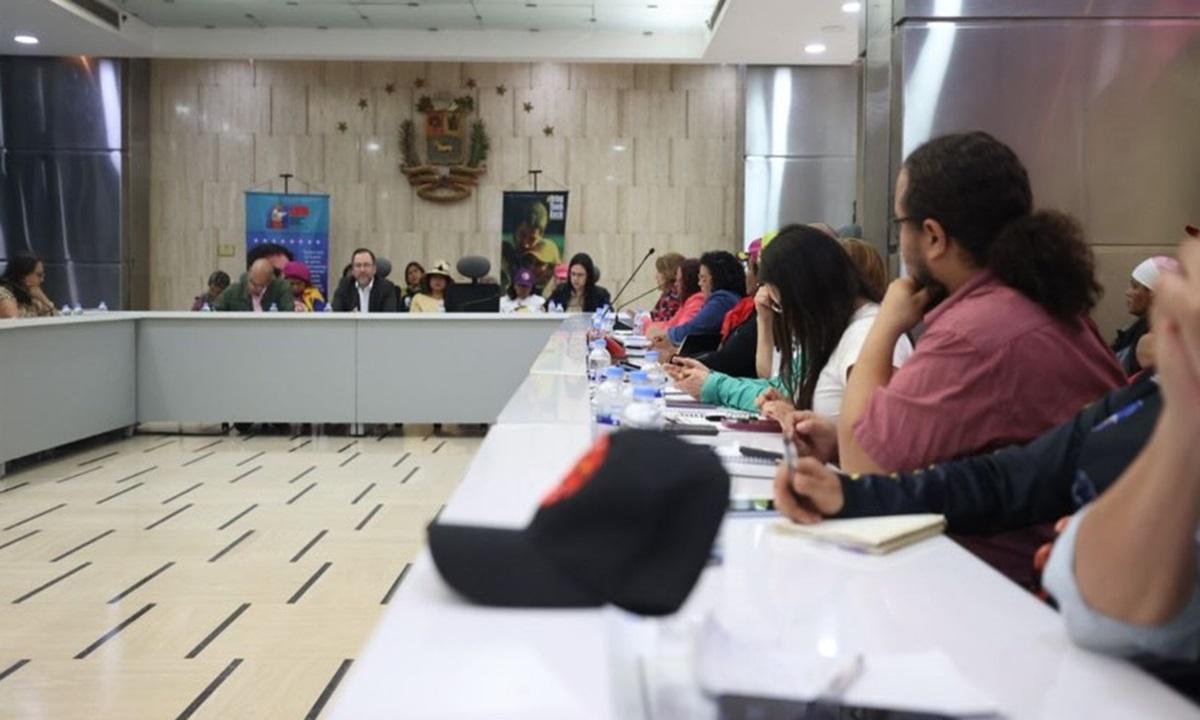
The Government of the Bolivarian Republic of Venezuela, through the Ministry of People’s Power for Foreign Affairs and the Simón Bolívar Institute for Peace and Solidarity, led an international meeting with social movements from more than 60 countries to ratify its unrestricted commitment to peace with social justice and the defense of national sovereignty.
The event, held both in presence and virtually at the seat of the Chancellory, served as a platform for Chancellor Yván Gil to emphasize Venezuela’s response to the serious events of January 3, which he described as «the worst stain in the region’s recent history.» Firm in the defense of self-determination, the diplomat stressed that the country’s response will not be brute force, but rather the Bolivarian peace based on «peace with social justice, sovereignty, and the integration of peoples.»
During his address at the 12th anniversary of the Proclamation of Latin America and the Caribbean as a Zone of Peace, promoted by CELAC, Gil acknowledged the technological asymmetries with respect to the military powers, but asserted that Venezuela possesses superior weapons: solid arguments, historical memory, and the international law: “We don’t have missiles or aircraft carriers, but we have the reason,” he declared, while thanking the solidarity of the brotherly peoples.
During the meeting, Deputy Tania Díaz, Vice President for International Affairs of the PSUV, announced a Great World Meeting to be held next March, with the purpose of unifying a global action agenda that denounces the violation of Venezuelan sovereignty and international law. Díaz urged to form solidarity committees for the release of President Nicolás Maduro and First Lady Cilia Flores, whom she described as living guarantees of national stability.
For her part, deputy Blanca Eekhout, president of the Simón Bolívar Institute for Peace and Solidarity, reported that the meeting brought together more than 500 international connections, with representatives from social movements, women, youth, Afro-descendants, workers, and legal professionals from Latin America, Europe, Africa, and the United States.
“We have not only had participation from all of Our Americas, but also from the mobilization that has been taking place in the United States since January 3, demanding the release of our president and Cilia Flores,” highlighted Eekhout, while denouncing the presence of lethal forces and nuclear weapons in the Caribbean as a threat to the Zone of Peace declared by CELAC in 2014 and to the spirit of the Tlatelolco Agreement.
Eekhout insisted that true peace is only possible through equality, justice, and the sovereignty of peoples, and announced that, as a result of the meeting, a continental action and mobilization plan was established to end the harassment, blockade, and siege against Venezuela, Cuba, and the peoples of the region.
“We assume as a fundamental task the sovereignty of the peoples of Latin America and the Caribbean as a guarantee of peace. This is the mission embraced by CELAC, a creation of our eternal president, Hugo Chávez: peace that is only possible with justice, sovereignty, and respect for international law,” she concluded.
The meeting also included the participation of Sectoral Vice President Héctor Rodríguez and representatives of the Venezuelan diplomatic corps, thus consolidating a historic day of global coordination for the dignity and self-determination of peoples.