

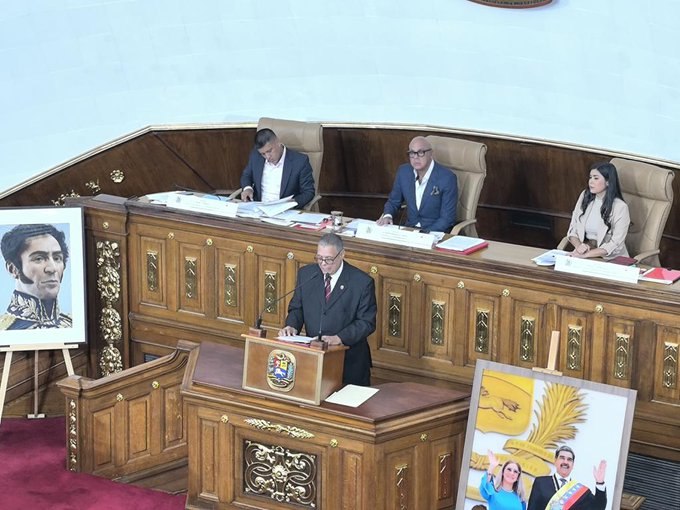
The National Assembly (AN) approved, in its first reading and unanimously, the Draft Organic Law for the Partial Reform of the Organic Law of the Electric System and Service during its ordinary session this Tuesday.
The justification for this proposal was presented by Deputy Orlando Miranda (PSUV/Lara), who explained that the partial reform aims to strengthen the protection of the electric system, the maintenance of infrastructure, and the optimization of service for the people.
Likewise, the deputy indicated that the reform seeks to pave the way for a modern, mixed, self-sustaining, and responsible electric system.
The deputy explained that the proposal, which comprises 42 articles, “represents a strategy that introduces a mixed and private capital scheme under a rigorous regime of concessions, public oversight, and civil and criminal co-responsibility of the operators.”
Likewise, he added that the core of the reform lies in the diversification of actors throughout the entire service chain: generation, transmission, distribution, and marketing.
He indicated that the law contemplates the participation of the Venezuelan State as a fundamental factor that opens the door to joint ventures where the Republic retains control with more than 50% of the social share.
He also stated that the legal instrument directly empowers citizens by segmenting obligations by sector. In this regard, he emphasized that distribution and marketing companies will be legally obligated to financially compensate users for damages caused by blackouts or deficiencies in the quality of supply.
Economic Viability:
Miranda explained that the reform represents economic viability in the design of tariffs, which takes into account real costs, which allows a reasonable profitability for investors based on efficiency criteria. He reiterated that this empowers the Executive branch and regional authorities to use fiscal policies as incentive mechanisms to exclusively address the country’s critical areas.
Finally, he asserted that the project represents a substantial element for the nation’s well-being and seeks to position the electricity sector at the forefront as a national and international benchmark for private and mixed investors, under the leading role of the Bolivarian Government and for the benefit of the people, just like the previously approved instruments regarding hydrocarbons, amnesty, and the judicial system.
Transformation of the State’s Role:
During the debate, Deputy José Gregorio Correa (AD/National) exposed his observations on the project, proposing that the legislation should transform the State’s role from that of a purely controlling or protective entity that guarantees the legal certainty necessary to attract investment from private companies and national and international organizations that may help to overcome the sector’s crisis:
«This law must modernize the electricity system in an efficient, accessible, and sustainable manner, and for this my proposal of support, in which we will all agree on, is to create an extremely important position such as that of the comptroller and defender of electricity efficiency.»