

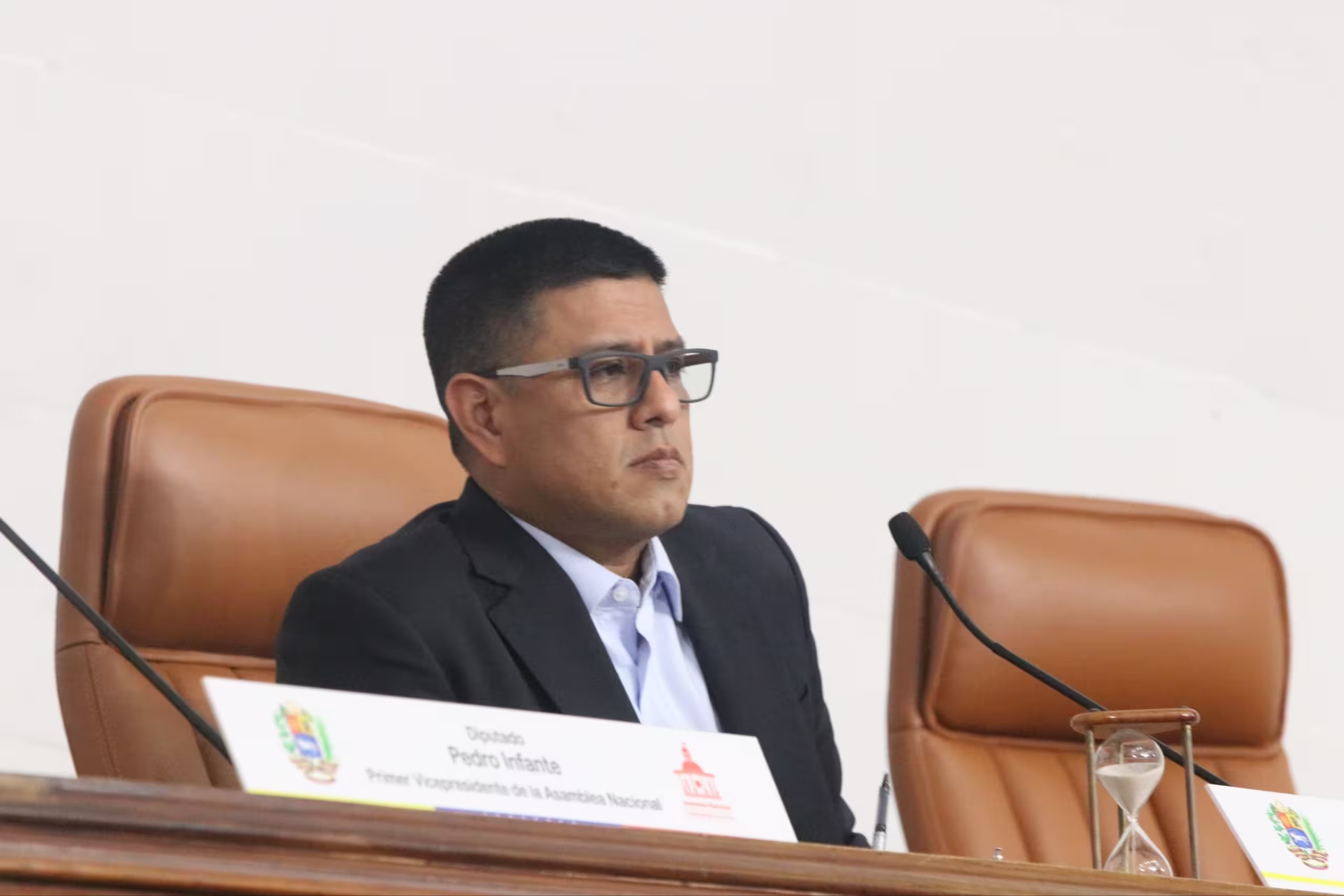
This Tuesday, the First Vice President of the National Assembly (AN), Deputy Pedro Infante (PSUV/Capital District), stated that the bill to reform the Law Against Hatred, for Peaceful Coexistence and Tolerance, will be aligned with the spirit of the current political moment.
Speaking from the gardens of the Federal Legislative Palace, the parliamentarian emphasized that the legal instrument will respond to the demands for peace, reconciliation, and tolerance that the country’s political context demands in 2026.
He announced that the Special Commission will hold another work session next Thursday at 10:00 a.m. and advanced that it is being evaluated to formally include two additional deputies in order to strengthen the drafting team’s technical and political capacity.
Infante specified that, once the commission completes the drafting phase, the proposal will be submitted to the Constitutional Chamber of the Supreme Tribunal of Justice (TSJ) for the necessary review.
He explained that the legal text will be presented to the Hemicycle of the Legislative Branch for its first discussion; once approved at this initial stage, a nationwide public consultation involving all social sectors will be deployed, for then giving way to the second discussion, final approval, and formal promulgation of the reform.
Generalized consensus:
Deputy Pedro Infante recalled that the parliamentary initiative stemmed from a communication sent by the President of the Republic, Delcy Rodríguez, last September 28. The letter was presented to the Plenary during an ordinary session on September 29, the date on which the Special Commission was established.
He stated that the work groups have already addressed and reviewed Articles 1, 2, and 3 of the text, corresponding to its purpose and fundamental principles, on which there is broad consensus among the members of the legislative body.
He explained that currently is undergoing an in-depth analysis of Article 18 of the current text, concerning the composition, relevance, and restructuring of the commission tasked with overseeing the promotion of values such as peace, reconciliation, and coexistence.
The experience gained during the drafting and participatory debate of the Amnesty Law, Infante added, serves as a valuable methodological precedent for this collective undertaking.
He highlighted the confidentiality with which has been safeguarded the commission’s internal deliberations during this initial drafting phase, although he ratified that in due course will be held open sessions with the attendance of the media so that the public could be informed of the details of the legislative debate.
Decriminalization and consensus:
The parliamentarian emphasized that the core focus of this review, proposed by the National Executive, is the decriminalization of the regulation.
When consulted about the stances of various sectors demanding either the total repeal of the text or to maintain it without alteration, he described both opinions as «extreme positions»:
«We must be capable to generate a law that allows us to reach a consensus across the whole Venezuelan society and continue accompanying the effort led by President Delcy Rodríguez to advance in the restoration of institutional order, peace, and democratic coexistence and the strengthening of our institutions to ensure confidence in the country,» he asserted.
He also noted that the decriminalization process will have a direct, beneficial impact on the legal status of individuals who have faced legal proceedings under the application of this legal framework.
Reduction of political violence:
The assembly member reminded that the original law was drafted in 2017, amidst a climate of intense political violence marked by tragic incidents—such as the killing of Orlando Figuera and the stringing of wire across roads, which claimed the lives of several citizens.
However, he contrasted that panorama with the institutional and social reality of 2026, pointing out that political violence has since decreased significantly.
Infante considers that the legal reform must align with the new democratic dynamic, which is centered on respect, the recognition of diversity, and national reconciliation.
Regarding the call for nominations to make the Nominations Committee, he announced that interested individuals may submit their documents and résumés to the Parliament’s Preliminary Commission by this Friday for evaluation and consideration during the selection process.