

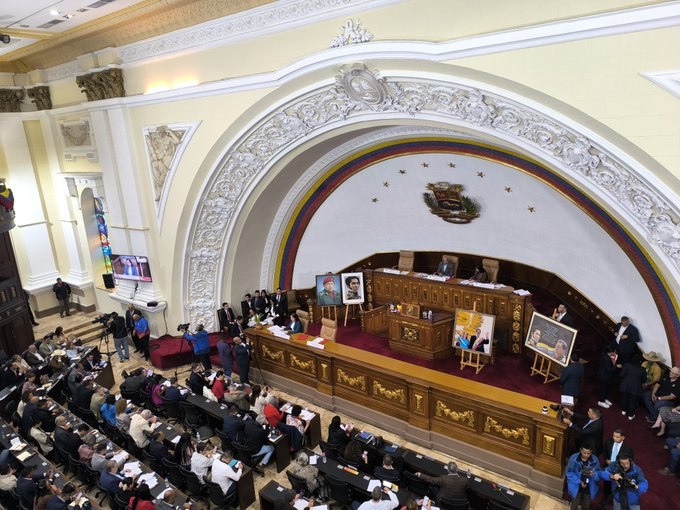
The National Assembly (AN) approved the Law for the Promotion and Development of Coffee, approved unanimously in its second reading during an ordinary session this Thursday.
The law aims to foster and promote the production, processing, industrialization, marketing, export, and sustainable and responsible consumption of coffee within the national territory, recognizing it as a sector of fundamental importance for the country’s development.
Among the benefits of this legislation are a plan to support producers with technical assistance, promote innovation, explore international markets, and establish a single management window to simplify and expedite administrative procedures.
The initiative will be supported by the «Café de Venezuela» (Coffee of Venezuela) Country Brand, which guarantees strict compliance with all health and quality certifications required in global markets.
It is also established that the Governing Body will promote, in a co-responsible manner, mechanisms for the active participation of farmers, women’s movements, youth, cooperatives, and socio-productive organizations in the design of public agricultural policies, under the unwavering premise of social justice.
In the new legal instrument, the National Executive will assume the task of implementing integral training plans and technical assistance at all levels of the education system, as well as within the production areas themselves, to support rural workers.
Likewise, the law mandates the Governing Body to activate immediate mechanisms for administrative simplification and efficiency to decentralize processes, a measure that will be implemented through the creation of a Single Agricultural Window in each coffee-growing municipality nationwide. With the aim of safeguarding the Republic’s plant heritage, Article 23 promotes the creation of germplasm banks to ensure the preservation of the crop’s originary biodiversity.
The regulation stipulates that its use will be exclusively for conservation, characterization, and controlled botanical reproduction. Likewise, the text recognizes coffee for its exceptional historical value as a symbol of Venezuelan identity, promoting its potential as a top-tier attraction for national and international tourism due to its unique aroma, flavor, and acidity.
During the reading of the articles on regulations for the agricultural health of coffee, the plenary session approved Article Six, concerning strict compliance with sanitary and phytosanitary technical provisions throughout the entire value chain.
This point generated a debate on legislative technique regarding the placement of the definition of the Governing Body, which falls under the ministry with jurisdiction over agriculture and land matters. Article Seven enshrines the precautionary principle and transitional measures to safeguard the environment against biological risks or actions lacking scientific consensus.
Producers showcase their harvests:
In a festive atmosphere in the halls of the Federal Legislative Palace, was lived a journey filled with aroma and tradition unfolded as national producers showcased their harvests, beans, and innovations in coffee cultivation.
The event served as an institutional prelude, allowing deputies, staff, and the general public to sample the exceptional quality of green coffee, roasted and hand-ground, produced in Venezuelan fields, adding a touch of color, identity, and dynamism to the day.
The exhibition enjoyed the institutional support of president of the Venezuelan Coffee Corporation, Josmary Borjas, and the presence of representatives from the Ministry of People’s Power for Foreign Trade and the Secretariat of Economy of Miranda state.
During the tour of the booths, the efforts of the agri-food sector were evident through iconic brands such as Café Amanecer (Portuguesa), Pino Café (Miranda), Café San José, Café Río Negro (Trujillo), Café Santa Cruz (Mérida), Café Yaracuy, Flor de Arauca (Anzoátegui), Kiwa Kafé (Táchira), and Café La Protectora (Trujillo).
Also participated representatives from the National Federation of Coffee Growers, among other producers, reaffirming the sector’s potential to supply the national market and to conquer international markets.
For their part, the producers reaffirmed their commitment and spirit to continue promoting the traditional best practices of the different geographical regions of Venezuela, demonstrating through their actions that agricultural work is the primary guarantee of the country’s food sovereignty.
This massive participation of the productive sector at the parliamentary headquarters responds directly to the formal invitation extended by the president of Parliament, deputy Jorge Rodríguez (PSUV/National) during a recent inspection of the producer Café Santa Cruz in Mérida state, last May 25.