

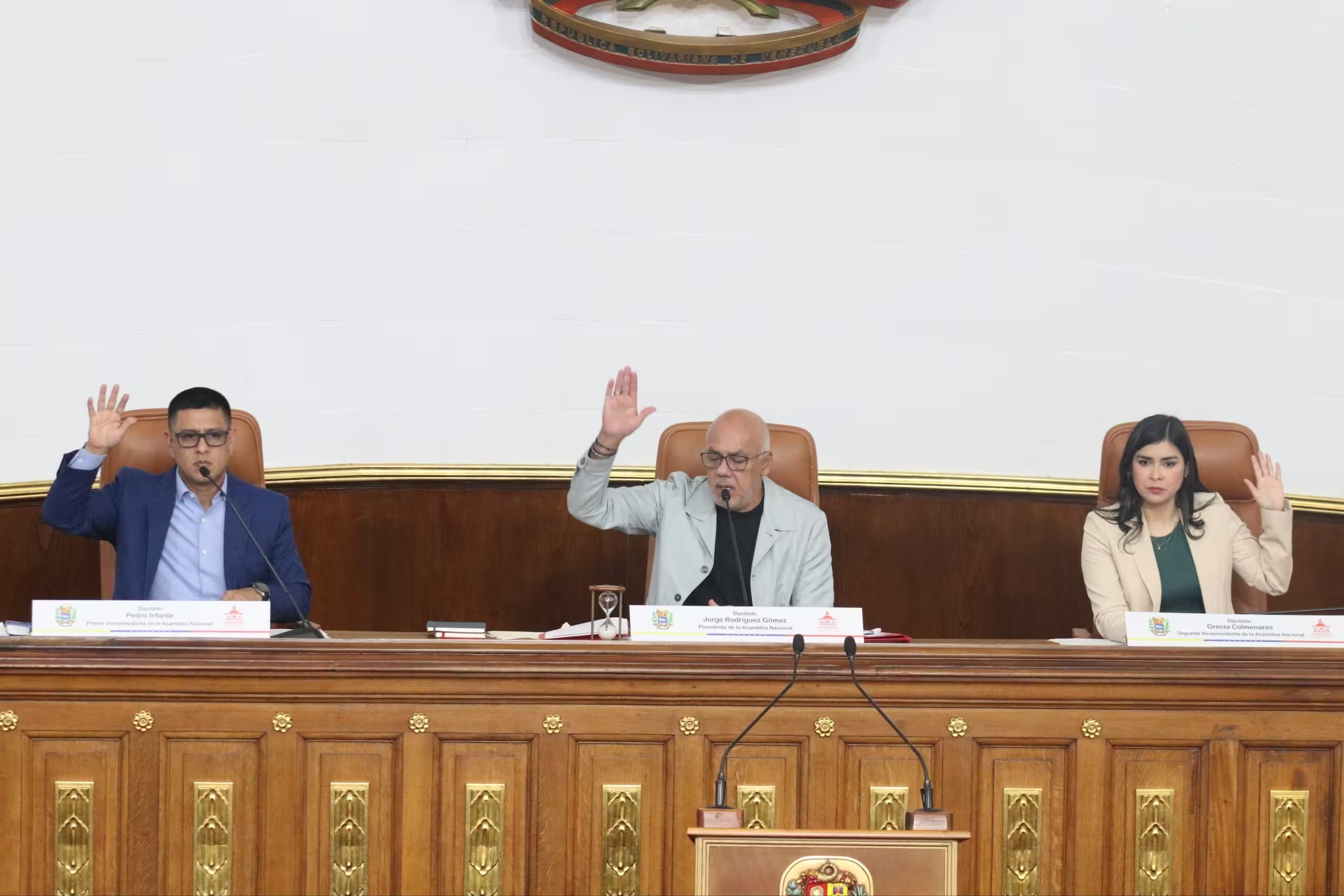
The National Parliament enacted this Tuesday, during an ordinary session, the reform of the Organic Law on the Electrical System and Service, a regulation that establishes provisions for governing the energy grid and power supply.
The law, which will be immediately forwarded to the National Executive for promulgation, also sets out rules for the international exchange of energy, covering generation, transmission, system dispatch, distribution, and commercialization.
The second reading of the text began on October 22 and spanned four ordinary sessions. So far this year, the Parliament has enacted 14 laws.
Community-based social comptrollership:
The decentralized and participatory framework extends to coordination with local governments, mandating that municipal authorities facilitate the creation of grassroots networks to ensure the timely identification of faults.
Under Article 32, municipalities are required to organize initiatives alongside community organizations to provide guidance on monitoring the service, while also cooperating with the utility provider on maintenance and the implementation of local programs.
In addition, Article 41 establishes the active involvement of «Technical Energy Councils» in developing proposals for technical support plans and community electrification projects, ensuring that decisions are tailored to the specific realities of each zone.
Promotion of the rational use of energy:
The newly approved law grants a leading role to organized communities in awareness campaigns focused on the efficient use of electricity and the preventive care of local power grids.
Article 32, subsection 6, mandates the development of continuous training programs geared for organizations of the People’s Power, covering energy conservation and the protection of infrastructure against unauthorized connections or acts of sabotage.
In line with these obligations, Article 30, paragraph 18, stipulates that service operators must coordinate with users and community structures to ensure the perimeter protection of substations and power lines, thereby consolidating a defensive framework for shared security between the State and organized communities.
Sanctioning regime:
The legislative framework, approved by the National Assembly (AN), establishes a rigorous system for determining liability and applying corrective measures in the event of regulatory non-compliance.
Pursuant to Article 101, the Superintendency of the National Electric System is directly empowered to initiate administrative investigations, enforce compliance with regulations, and take appropriate action against operating companies, members of their boards of directors, service providers, and users.
Classification of Sanctions:
Infractions committed by operating companies are classified according to their severity to ensure the stability of the public service.
Article 102 mandates severe sanctions up to 2 percent of the previous year’s gross revenue, for serious offenses such as repeated failure to meet quality standards, unjustified refusal to grant access to the grid, or unauthorized alterations to supply levels or tariffs.
Meanwhile, Article 103 governs less serious offenses, with penalties set at up to 0.2 percent of gross revenue for occasional operational irregularities or delays in the settlement of transactions within the electricity market.
Regulation of self-generation:
In matters of self-generation and independent systems, Article 104 establishes fines ranging from 1,000 to 10,000 times the official exchange rate of the highest-valued currency published by the Central Bank of Venezuela, applicable in cases of non-compliance during states of exception or emergency situations.
Following a debate regarding the technical precision of the regulation, the Plenary incorporated safeguards to account for justified material or technical impossibility, while ensuring due process, the right to a defense, and fair compensation for energy supplied to the National Electric System.
Administrative Revocation:
The legal framework provides for severe measures in response to serious offenses that compromise national security. Under Article 105, owners of self-generation facilities with a capacity exceeding two megawatts who withhold electricity supply during a state of exception, declared by the National Executive, face the direct revocation of their administrative authorization, in addition to any applicable fines.
Likewise, Articles 107, 108, and 109 impose fines—ranging from 100 to 10,000 times the official exchange rate of the highest-valued currency, as published by the Central Bank of Venezuela, on those who carry out unauthorized work that disrupts, obstructs, or damages utility easements or electrical infrastructure.
Fines applicable to users:
To ensure the integrity and responsible use of the National Electric System, Article 106 defines user infractions and establishes a system of monetary penalties proportional to the severity of the offense.
Fines range from 50 to 50,000 times the official exchange rate of the highest-valued currency, as published by the Central Bank of Venezuela, and apply to actions such as unauthorized changes in energy usage or the creation of illegal connections.
This also extends to the tampering with or damaging of meters, refusing access to authorized personnel, the clandestine supply of energy to third parties, and failure to comply with regulations regarding the rational and efficient use of electricity.
Penalties for offenses in the sector:
The regulations establish a framework for criminal classification to protect the country’s electrical infrastructure. According to Article 110, the administrative actions and sanctions provided for herein shall expire (prescribe) after five years, calculated from the date the infraction was committed or from the date of the final decision in an administrative proceeding.
Criminal penalties for electricity theft:
The final stage of the legislative debate included the approval of criminal provisions designed to safeguard the physical and operational assets of the National Electricity System.
In accordance with Article 114, a prison sentence of two to six years was established for those who, for profit, misappropriate electrical energy through unauthorized connections exceeding 5,000 kilowatt-hours per month.
Likewise, Article 115 imposes a prison sentence of two to five years for the theft of equipment or installations used for the provision and metering of electrical service, regardless of whether the act is committed for profit, thereby protecting infrastructure against the removal of essential components.
Standardization and regularization programs for supply points:
To address the realities faced by communities and to structure operational solutions regarding service, the first transitional provision mandates that the state-owned operating company develop and implement a comprehensive program to standardize supply points over a five-year period.
In those exceptional cases such as areas with uncontrolled development or those that are difficult to access, where the installation of individual metering devices is not feasible, the company may agree upon alternative billing schemes with organizations of the People’s Power, for a period not exceeding two years.
Technological upgrading:
The transitional provisions establish operational timelines for the institutional and financial adjustment of the electricity sector following the enactment of the law.
The second transitional provision grants a two-year period for updating the user database, while the third mandates that the National Executive establish a fund to finance subsidies within a period of no more than one year.
Finally, a 180-day timeframe is set for the drafting of the relevant regulations and for the operational integration of the National Dispatch Center into the structure of the ministry responsible for electrical energy.