

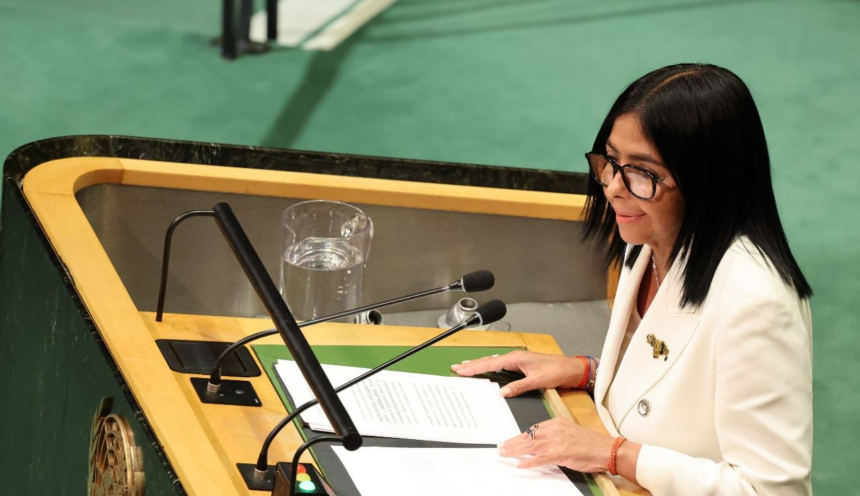
During the second day of sessions at the 81st UN General Assembly, the President of the Bolivarian Republic of Venezuela, Delcy Rodríguez Gómez, highlighted the recent hydrocarbons agreement subscribed between Caracas and Washington as a key factor for the global oil market. «I highlight the new United States-Venezuela binational agreement as one of the largest ever signed, and one that will contribute to energy balance within the hemisphere and the international economy,» she emphasized at the start of her address.
Within this context, the head of the Executive Branch argued that global economic stability depends directly on the responsible management of the sector, noting that «international stability requires resolving the energy trilemma: simultaneously guaranteeing supply security, affordable prices, and environmental sustainability.»
Likewise, she warned on international pressures regarding the ecologic transition, manifesting that «to promote forced decarbonization programs poses a direct threat to food security, employment, and production.»
Regarding the strategic guidelines of the Venezuelan delegation at the UN, the first point addressed peace and conflict resolution; she asserted that «Venezuela firmly believes in the power of understanding and dialogue. We reaffirm unequivocally that peace—a just, lasting peace with dignity for all parties—is not a naive aspiration, but the only truly human path forward.»
On the second point, focusing on development and the impact of sanctions, the leader stated that «sanctions undermine economic and financial freedoms and hinder human development,» highlighting the urgent need to foster «inclusive development with social justice to mitigate poverty and alleviate the suffering of hundreds of millions of people, primarily in the Global South.»
Regarding the third point—respect for nature—she affirmed that her nation upholds «respect for the rights of nature as the only path to the preservation of human life.»
On the fourth point, while addressing the international exchange system and national industry, he warned of «the institutional failure of global trade,» emphasizing that «no nation can prosper under supranational frameworks that fail to promote national industry and that reward offshoring.»
On the fifth point, concerning international stability, she demanded to resolve the energy trilemma: to simultaneously ensure supply security, affordable prices, and environmental sustainability.
On the sixth point, dedicated to Artificial Intelligence and the technological divide, she highlighted that «we are in the presence of a transformative milestone for humanity that, if harnessed correctly, will lead to unprecedented development», and urged the governments and the technology sector «not to divert the constructive and vital purpose of IA of benefiting citizens, nor to exacerbate the digital divide and inequality in the world.»