
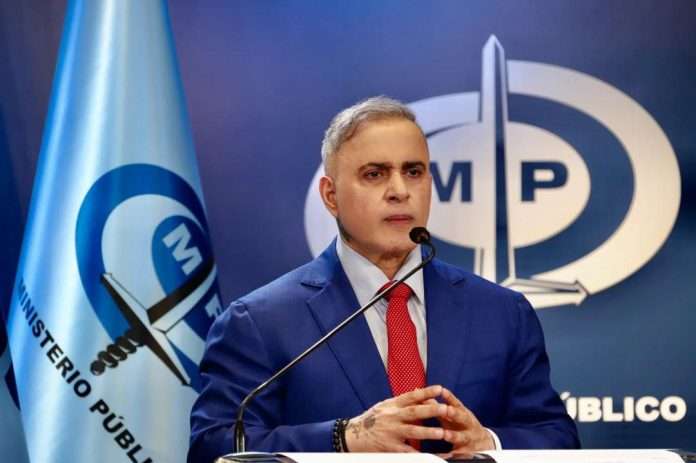
The President of the Republican Moral Council and Attorney General of the Republic, Tarek William Saab, stated that the Citizen Power unanimously supports the draft of Amnesty Law promoted by the Acting President of Venezuela, Delcy Rodríguez.
During a «Public Prosecutor’s Office Goes to Your Community» journey held last Thursday in Los Palos Grandes Square in the Chacao municipality (Caracas), the head of criminal prosecution expressed that the Citizen Power «takes a step forward in its support and this gesture of agreement and reconciliation» on the part of the national Executive.
In this sense, he emphasized that the bodies he leads have contributed ideas and input to the aforementioned draft bill that is currently being debated within the bosom of the National Assembly, according to a press release of the Public Ministry.
He said that from the Public Ministry presented were presented some considerations that were taken into account for the aforementioned draft bill.
«We have held meetings at the National Assembly, we have participated in work groups with members of the program for (democratic) coexistence and peace, and with other members of the parliamentary commission that is discussing and debating this draft for the Amnesty Law,» highlighted Saab.
He described the initiative as exceptional because it covers the most important historical moments of contemporary Venezuela over the last quarter of a century, and he hopes that the amnesty law will guarantee a «100% pacified» country where the crimes included in the draft law will not be repeated.
He also emphasized that he is extending a hand to sectors that participated in coup attempts against President Hugo Chávez, who were responsible for the oil strike and other insurrectionary actions in February and March 2014, as well as those of April, May, June, and July 2017: “They were detained for actions that were documented at the time.”
He also recalled “violent actions that were given with the potential result of deaths and injuries, such as those that occurred during the post-election demonstrations of July 28, 2014, among others.”
Past Without Amnesty:
The representative of the institution guarantor of the rule of law in the country mentioned that the governments of Rómulo Betancourt and Raúl Leoni established state terrorism and forced disappearances.
He recalled that, according to unofficial figures studied by the national human rights movement of the time, there were 50,000 civilian detainees in the country, who were tried in military courts.
He said that back then were also carried out targeted killings, such as those of Livia Gouverneur and Fabricio Ojeda, as well as massacres of peasants, and that there were operation theaters against guerrilla used to illegally detain people and torture them in those spaces.
He mentioned the case of young Noel Rodríguez, who was disappeared and murdered in an operations theater in Sucre state:
“There were 5,000 murders and 3,000 disappearances during a period in the 1960s decade, and would you think there was an Amnesty Law?” demanded the president of the Republican Moral Council.
He noted that were also disabled political parties with senators and representatives in Congress, in order to take them to an unequal process of armed struggle, in which an entire generation was exterminated.
A Model in the World:
In response to attacks on the draft for the Amnesty Law, the head of criminal prosecution emphasized that this initiative should not be sabotaged:
«There may be divergences to reach agreements, but it must not be sabotaged; that is my call,» reflected the Attorney General.
He indicated that, amidst the consultations, they will continue contributing ideas so that the amnesty law becomes a model for the world.
Street Justice in Numbers:
The Attorney General of the Republic, Tarek William Saab, reported that to date, 115,543 people have been assisted through the various street justice programs advanced by the Public Ministry.
During a «The Public Prosecutor’s Office Goes to Your Community» journey held this Thursday, February 12, in Los Palos Grandes Square in the Chacao municipality (Caracas), the also president of the Republican Moral Council specified that 10,265 denounces of a criminal character have been filed so far.
In this sense, Saab emphasized that these types of activities will continue to expand simultaneously in different regions of the country to serve the people “wherever it needs it.”
Total figures of people served:
During the event, the head of criminal prosecution in the country revealed the figures for people served throughout the national territory, both in prosecutor’s offices as in during street justice journeys, which to date total 4,827,128 persons.
He stressed that this effort is the product of daily and systematic work, and that “even in the worst moments, such as last January 3, these types of activities did not stop,” according to a press release of the Public Prosecutor’s Office.
“We were there to demonstrate that the Venezuelan State works, the consequence of which is peace and calm throughout an entire country, and a people who wants to live peacefully,” he stated.
In this opportunity, he reported that 120 people were assisted in the Los Palos Grandes square, who delivered denounces related to injuries, disturbances, animal abuse, invasions, fraud, unauthorized access, human rights violations, and gender violence.
“Please note the importance of addressing cases like these in public spaces, in addition to the prosecutor’s offices; this should be highly valued,” manifested Saab.
Regarding the orientations, he indicated that 54 consultations were provided, as well as 11 cases involving expediting legal proceedings and 2 of social assistance.
He explained that this initiative was made possible with the support of the Citizen Power, the Víctor Valera Mora Library of the Public Ministry, the National School of Prosecutors, the Municipal Justice House of Chacao, and the Salud Chacao Health Services.