

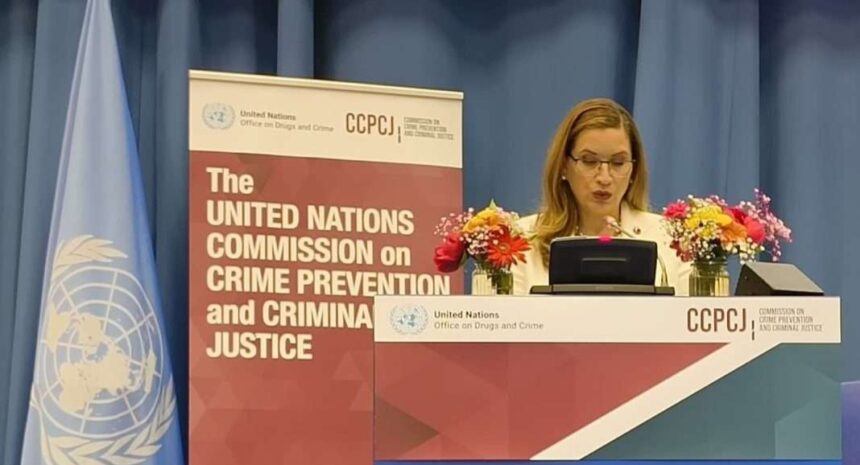
Venezuela presented to the United Nations (UN) in Vienna, Austria, the advances of the national consultation for the reform of the Criminal Justice System in the country. This process, which began on June 1, aims to prioritize procedural efficiency, strengthen the integrity of the courts, and eradicate the criminalization of poverty, as refers a press release from the Venezuelan Chancellory.
The presentation took place during the general debate of the 35th session of the Commission on Crime Prevention and Criminal Justice (CCPCJ). The Venezuelan delegation, led by Ambassador Claudia Salerno, Permanent Representative to the International Organizations in Vienna, emphasized that the Executive and Legislative branches convened the national consultation to facilitate discussions involving public defenders, judges, prosecutors, and organized communities. The consultation successfully identified critical issues in the area of the criminal justice system.
During her address, Salerno highlighted that the National Assembly recently approved the Partial Reform of the Organic Law of the Supreme Court of Justice, a legal instrument promulgated by the National Executive in May 2026, which establishes a series of structural adjustments aimed at optimizing response times in the criminal and civil justice systems.
Within the framework of the general debate of the 35th session of the UN Central Committee on Criminal Justice (CCPCJ), Venezuela reaffirmed its commitment to the fundamental principles of the 2021 Kyoto Declaration, emphasizing that crime prevention and the criminal justice must underpin the construction of equitable, peaceful, and sustainable societies.
Within this context, Salerno denounced that the imposition of unilateral coercive measures against Venezuela directly impacts judicial institutions, hindering their capacity to combat and prevent crime by limiting international cooperation and access to new technologies through financial sanctions.
Finally, Venezuela reiterated that crime prevention and combating crime in its various forms is a common and shared responsibility that requires an integral and balanced approach.
This effort must be carried out in full accordance with the purposes and principles of the Charter of the United Nations, the international law, and the Universal Declaration of Human Rights, fully respecting the sovereignty and territorial integrity of States, the principle of non-intervention in internal affairs, and mutual respect, as reads the statement.