
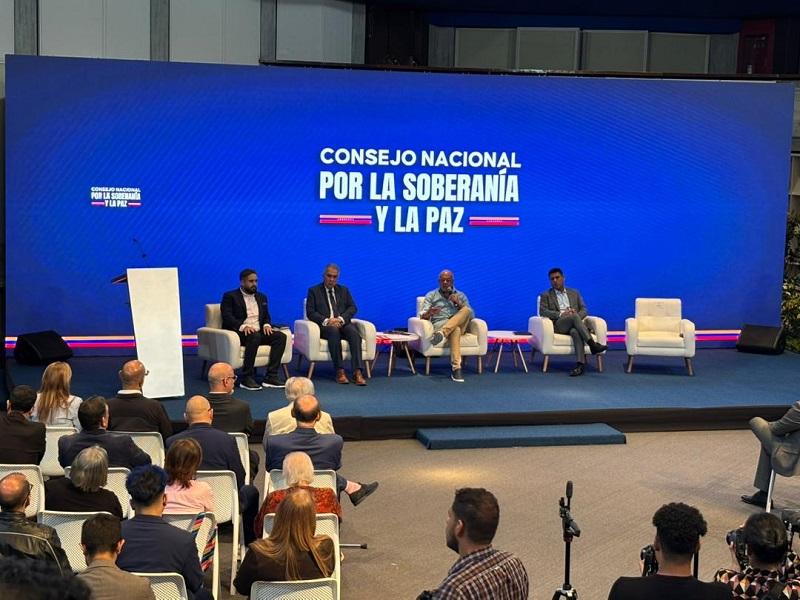
The coordinator of the National Council for Sovereignty and Peace, Jorge Rodríguez, upon inaugurating the Media chapter of this body, called on the media to become defenders of the truth, in the face of the constant opinions generated by international conglomerates.
At the meeting, Rodríguez emphasized that the truth is the first casualty in any conflict, a phenomenon that is amplified in the era of social media controlled by «a few surnames.»
He called on members of the media to «defend Venezuela, defend the truth, defend life, and defend peace.»
He also denied the supposedly «unsustainable situation» in Venezuela, citing the influence of thousands of people from other countries who, upon arriving, discover a country at peace. He called for «taking care of our home» and defending the Venezuelan identity, marked by hope, joy, and freedom—values that, in his opinion, «burn too much» for the aggressors.
In his speech, he severely questioned the United States’ strategy in the fight against drug trafficking, suggesting that the true intention is not to combat drugs, but rather to undertake violent actions against Venezuela.
During the inauguration of the National Council for Sovereignty and Peace: Communication Chapter, Rodríguez stated that the United States should prioritize the internal fight: «If the government of the United States of America truly wanted to combat drug trafficking, it should start at home, since it is the world’s leading consumer of cocaine.» He indicated that Washington’s true intention is to besiege and seize the country’s natural resources.
He mentioned that the opioid addiction crisis in the United States is generated by large laboratories.
Citing an analysis by The New York Times, he ratified the denounce made by President Nicolás Maduro: «85% of the drugs that reach the United States pass through other routes, not through Venezuela.»
For his part, Representative Nicolás Maduro Guerra acknowledged the positive evolution of the national media, noting that, unlike past historical moments such as the coup d’état in 2002, where «what was happening on the streets of Caracas was completely silenced,» today “there is a plural voice, a diverse voice, a voice that has criticism, but is aligned with the country.»
He emphasized the great responsibility of this communication movement to counter the international narrative, and therefore urged a «greater effort» to show the world the reality of a Venezuela «in resistance, growing, and working.»