
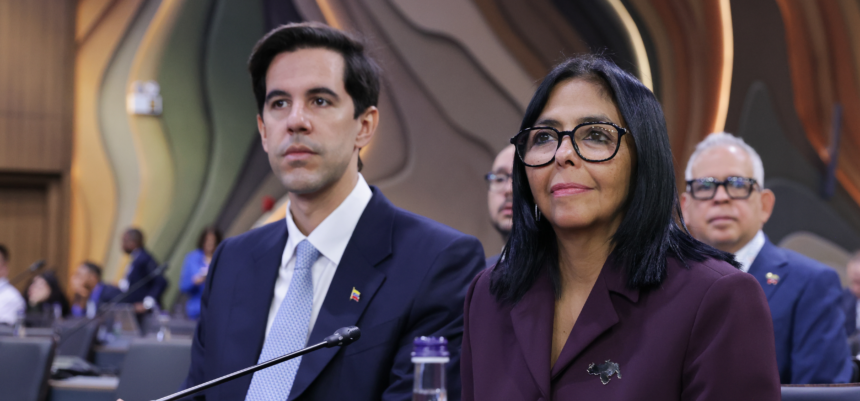
At COP31, held in Türkiye, the President of the Bolivarian Republic of Venezuela, Delcy Rodríguez, emphasized that the development of the energy sector can progress alongside environmental protection, and she defended Venezuela’s sovereign right to responsibly advance its industry: «A just transition does not shut down economies; it transforms them,» she explained.
The President stated that the country is working to incorporate more renewable sources into the National Electric System (SEN), including photovoltaic energy.
«Since 2018, we have reforested nearly 70,000 hectares, and today, 80% of our electricity generation comes from hydroelectric sources,» said the President. She also highlighted the role played by communities and environmental organizations in caring for ecosystems and developing risk maps.
She added that the country recognizes the importance of measures for adaptation, mitigation, and addressing loss and damage. In this context, she detailed that «it is possible to grow while simultaneously protecting and caring for the environment.»
The energy challenge:
The Head of State addressed the need to balance security of supply, affordable prices, and environmental sustainability. She warned that 655 million people lack access to electricity, and 2 billion do not have clean alternatives for cooking.
«Decarbonization must not exacerbate energy poverty or penalize the most vulnerable. It must be fair, viable, and affordable,» she stated.
Regarding oil production, the Head of State reported that for four consecutive years Venezuela has reduced the flaring intensity per barrel, and that the modernization of the industry entails further lowering its emissions.
Finally, she called for international cooperation, technology transfer, and respect for national circumstances, while urging developed nations to fulfill their financing commitments: «Developing countries need $310 billion a year to adapt, yet they receive less than $26 billion. That gap is also an emergency,» she sentenced.