
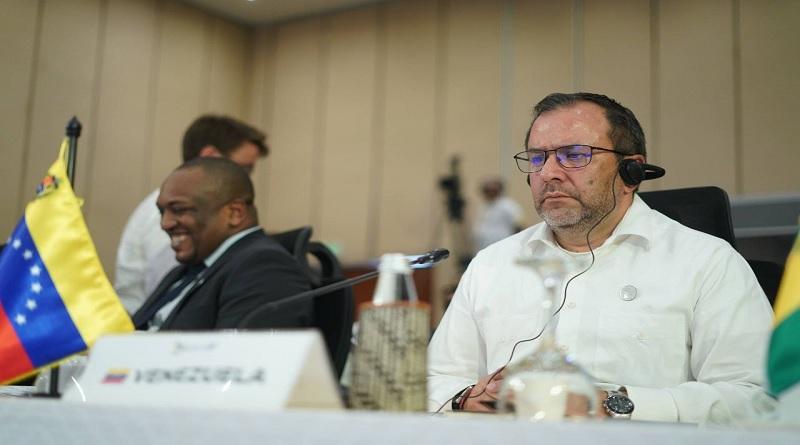
Within the framework of the 4th Summit of Heads of State and Government of the Community of Latin American and Caribbean States and the European Union (CELAC-EU), the Chancellor of the Bolivarian Republic of Venezuela, Yván Gil, called for a revival of integration values and the consolidation of a unified position in the face of challenges threatening regional stability.
With a firm speech, Chancellor Gil advocated for the unconditional proclamation of the region as a “Zone of Peace,” a foundational principle for collective action. In this regard, he demanded “a categorical rejection of any militarization of the Caribbean,” warning of the risks posed by the increasing deployment of foreign military forces. “This Summit must be the clear voice that defends sovereignty and peace on our coasts and lands,” he affirmed.
In one of his most prominent remarks, the Venezuelan diplomat focused on the crucial defense of human rights. Gil formally and urgently demanded “an independent investigation into the executions reported by UN human rights mechanisms. Only through truth and impartial justice can we guarantee the effective protection of our people,” he asserted.
Stressing this commitment, the Chancellor added that transparency in these processes “is not an option, it is an obligation to human dignity.” With this stance, Venezuela positions itself as an actor committed to international law and universal justice before the community of nations.
The declarations by Chancellor Gil reaffirm Venezuela’s historical commitment to the principles of non-intervention, peace, and self-determination. His remarks urged the countries of Latin America, the Caribbean, and Europe to act with shared responsibility and strategic cohesion in the face of common challenges, emphasizing that regional strength lies in the capacity to engage in dialogue based on mutual respect.
The Venezuelan participation in this 4th CELAC-EU Summit marks a clear and constructive position, aimed at strengthening multilateralism and building a joint agenda that prioritizes peace, justice and sovereign development as central axes of bi-regional relations.