
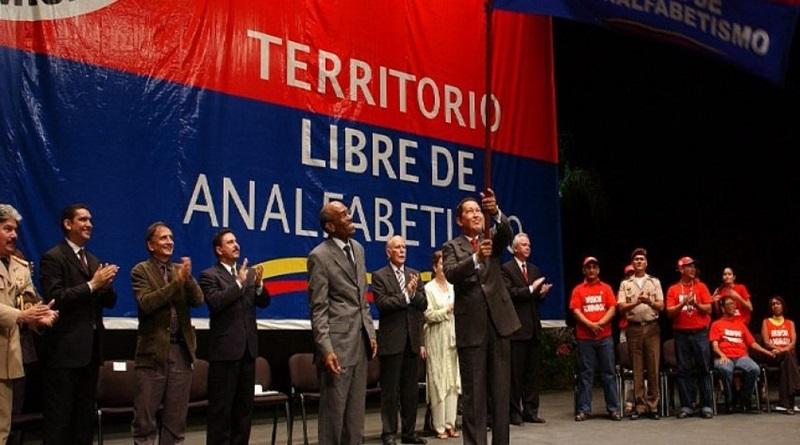
This October 28 marks 20 years since the United Nations Educational, Scientific and Cultural Organization (UNESCO) declared Venezuela a territory free from illiteracy, a fundamental milestone of the Bolivarian Revolution. Thus was remembered by the Chancellor of the Republic, Yván Gil, who recalled the significance of this achievement attained in 2005.
Minister Gil, through his Telegram channel, emphasized that this social achievement was a direct result of the literacy policies promoted by Commander Hugo Chávez. The central objective of these initiatives was to guarantee universal access to basic education, a fundamental right historically denied to large sectors of the population:
“This achievement was part of a national and popular mobilization to promote social inclusion, human development, and the full participation of our people in the country’s economic and political life,” can be read in the publication by the Chancellor. He also emphasized that, two decades later, the national government continues to promote comprehensive education for all, “from schools to the communes and self-governance.”
The starting point for this path was the launching of the social missions in 2003 by the leader of the Bolivarian Revolution, Hugo Chávez. With the aim of providing free educational tools was created Mission Robinson, implemented through the “Yo sí puedo” (Yes, I Can) method.
Thanks to this program, 1.5 million people, mostly senior citizens, learned to read and write. The initial success led to the creation of Mission Robinson II, encouraging the population to pursue studies from first through sixth grade of basic education.
Later, with the Ribas and Sucre missions, a step further was given, enabling thousands of Venezuelans to complete their secondary education and even enter university. Thus, the UNESCO declaration was not an end point, but rather the beginning of an ongoing process of educational inclusion.