
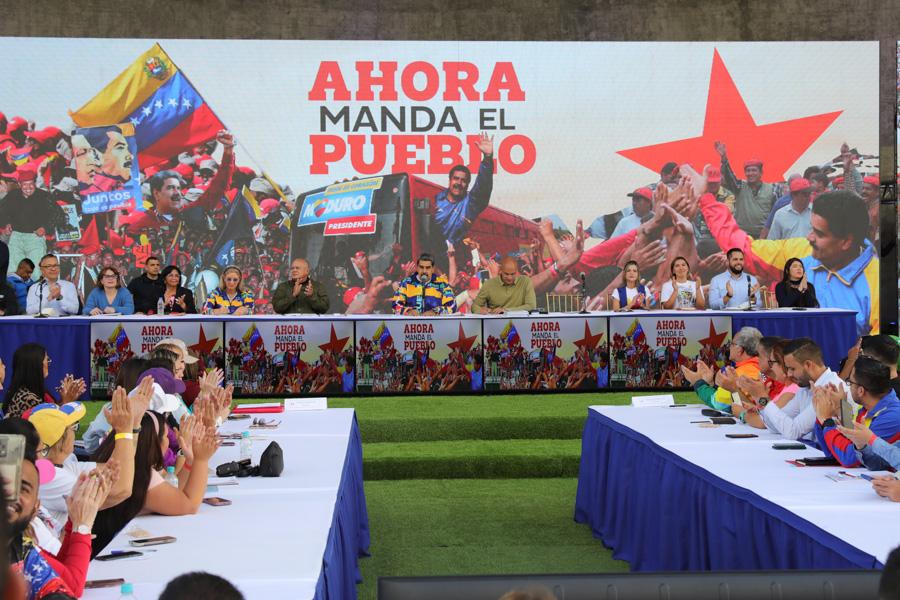
During the commemoration of the 35 years of the military rebellion of February 27, 1989, the President of the Republic, Nicolás Maduro, exalted the rebellious character of the Venezuelan people by reacting against neoliberalism, demagoguery and deception promoted by sectors of the time:
“We had to live through that decade of the 80s, of betrayal, misery, looting in the governments of family names, of that oligarchic, elite Fourth Republic and we saw how the country was getting out of hand, falling apart, decomposing and later,” the President recalled from the Concha Acústica 27 de Febrero, located in the Simón Bolívar Park, in Miranda state.
In context, he expressed that former president Carlos Andrés Pérez signed an agreement with the International Monetary Fund (IMF) “and the people began to see what was happening on February 18 and 9 days later in what is called the Caracazo (*), the people of Venezuela lived and was the protagonist of the first world rebellion against the IMF, against neoliberalism, surnames and oligarchies.”
In this sense, he assured that after the events of FEB-27 emerged February 4, 1992 and a torch was lit to illuminate the path:
“We went from the massacred rebel people to the constituent people to build this path, a time of rebirth, of refoundation, hope, illusion, of love for our Homeland (…) and came to power in that great electoral victory of 1998,” he reflected.
On February 27, 1989, during the Caracazo, Venezuelans protested against corruption, the increase in fuel prices and the value of public transportation fares. This popular rebellion began in Guarenas, Miranda state and continued in Caracas, spreading to the main cities of the country.
“There are 35 years of perseverance, of coming from the hell of darkness to the light, to the hope of the future (…) It is forbidden to forget the people of Venezuela, it is forbidden to forget the massacres, the brutality of the surnames and the oligarchy when they had power. «Forbidden to forget!» concluded the Dignitary upon receiving the proposals of the national debate on the Seven Transformations (7T) towards 2030.
(*): “Caracazo” refers to the popular uprising of February 27, 1989, which was a response to the economic measures implemented by the government of then president Carlos Andres Perez in accordance with the plan traced by the International monetary Fund. The uprising led to a violent armed response by the security forces, which resulted in deaths and forced disappearance of people.