
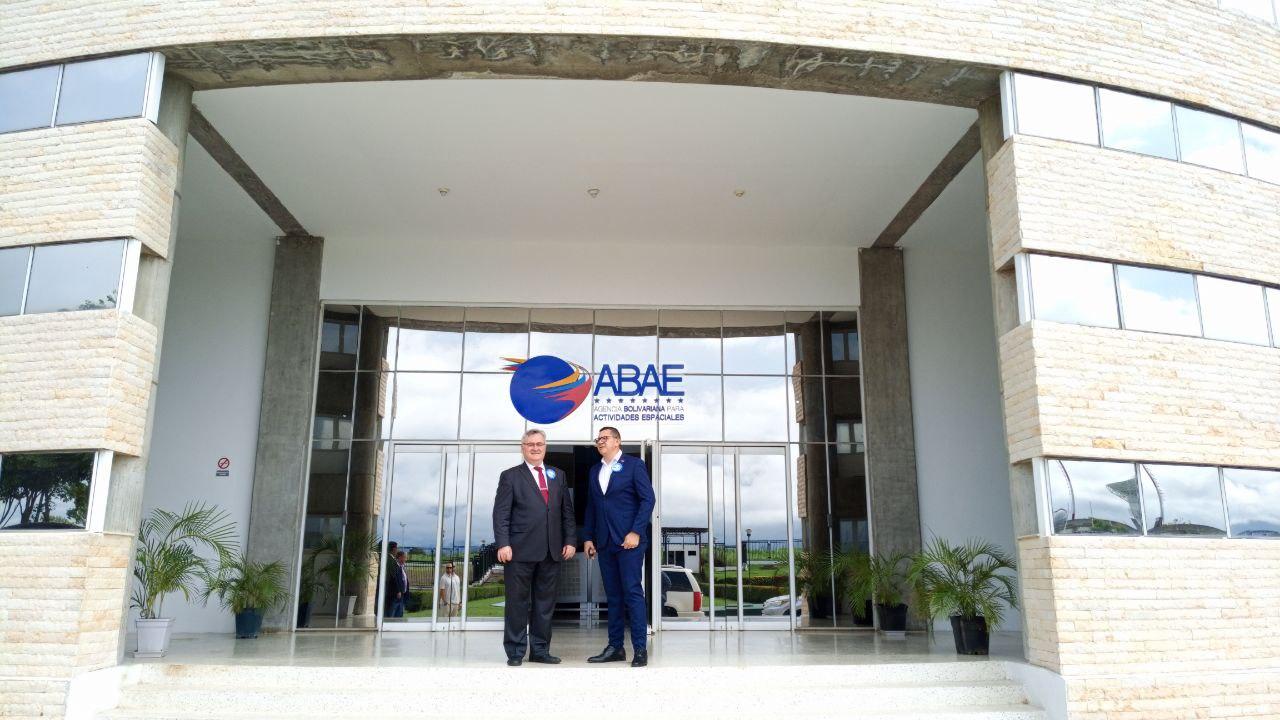
The Bolivarian Government of Venezuela made a transcendental step toward technological sovereignty with the inauguration of the first GLONASS station in the country, installed at the Satellite Ground Control Station (ETCS) of the Bolivarian Agency for Space Activities (ABAE), located at the Captain Manuel Ríos Aerospace Base (BAEMARI) in El Sombrero, Guárico state. The event took place on July 9, 2025, and marks a milestone of great scientific, geopolitical, and sovereign significance, consolidating cooperation between the Bolivarian Republic of Venezuela and the Russian Federation.
The GLONASS station, part of the Global Navigation Satellite System developed by the Russian Federation as a sovereign alternative to GPS, will strengthen geolocation, synchronization, and satellite monitoring services in Venezuela. This facility will optimize applications in geodesy, precision agriculture, transportation, telecommunications, industrial monitoring, and critical infrastructure management, in addition to promoting the training of national talent specialized in GNSS systems.
The construction of this station is part of the Strategic Partnership and Cooperation Agreement signed between the two countries, which covers 12 areas of space cooperation. It was supported by the State-owned Space Corporation ROSCOSMOS and the Public Limited Company Corporation for Research and Production of Precision Instrument Systems (SA CIP SIP).
At the ceremony were present Raúl Hernández, Deputy Minister for the Development of Information and Communication Technologies of the Ministry of People’s Power for Science and Technology (MINCYT); Adolfo Godoy, President of the ABAE (Bolivarian Agency for Space Activities); His Excellency Sergey Mélik-Bagdasárov, Ambassador of Russia to Venezuela; and representatives of ROSCOSMOS and SA CIP SIP, including Aleksander Bochkarev, Elena Zhurinova, Roy Yuri, and Konstantin Tokarev. The Director General of ROSCOSMOS, Dmitry Bakanov, participated remotely.
GLONASS Station Strengthens Technological Sovereignty and Scientific Applications:
Deputy Minister Raúl Hernández described the inauguration as a historic milestone, highlighting that it is the first data station of a global system in Venezuela, which will allow access to independent satellite navigation services. “When we talk about a historic milestone, it also means feeling and knowing that we are witnessing a historic event in terms of the use of the system,” he said.
From Moscow, Dmitry Bakanov emphasized that “this new GLONASS station represents the most important step for the technological strength of sovereignty and the development of the Republic of Venezuela.” He explained that the data will be key for transportation, agriculture, and topographic surveys. We have already inaugurated stations in Nicaragua, Belarus, and Antarctica, but we are happy to be able to install this station here in Venezuela; it is wonderful,” he stated.
The President of ABAE, Adolfo Godoy, highlighted the political will and professionalism that made this achievement possible: “I want to thank ROSCOSMOS for this cooperation. It was an extremely important first step for us, and we are confident that, through this framework agreement, we will continue to make significant progress,” he said. He emphasized that the station will facilitate the acquisition of raw data, essential for scientific studies and for increasing the accuracy of navigation applications.
Russian Ambassador to Venezuela Sergey Melik-Bagdasarov noted that this achievement is the result of the strategic partnership agreement signed in May between Presidents Vladimir Putin and Nicolás Maduro, noting that “our joint journey to the stars is just beginning today.”
Roy Yuri, General DIrector of SA CIP SIP, explained that the goal is to improve the accuracy of GLONASS navigation signals and support the development of applied navigation technologies in the Western Hemisphere: “We currently have 13 stations abroad and plan to open more in the future,” he added.
With this inauguration, Venezuela strengthens its technological sovereignty, expands its satellite navigation capabilities, and consolidates a high-level strategic alliance with the Russian Federation, reaffirming its commitment to independent and multipolar scientific development.