
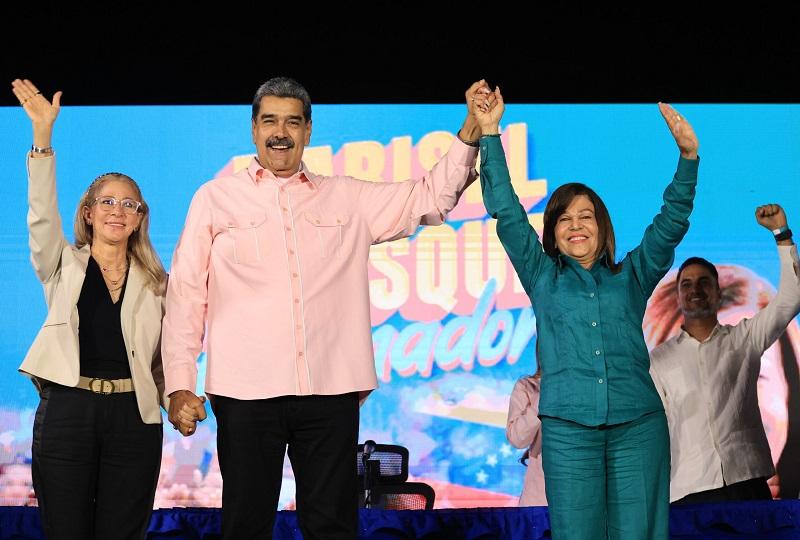
The President of the Bolivarian Republic of Venezuela, Nicolás Maduro Moros, led the inauguration of the governor elected by the eastern people (of Nueva Esparta state), Marisel Velásquez de Millán, on Tuesday. She obtained 81,322 direct votes, equivalent to 55.33% of the total votes.
The Venezuelan leader stated: «I knew this day would come, that with the sovereign and conscious will of the people of Nueva Esparta, this heroic land that saw the birth of South American independence, I would reclaim the political power of the governorship. I knew it would come, and it has come; today, a day of victory and renewed hope, a day of unity and a shared dream.»
President Maduro emphasized: «…I am sure that Marisel will be a successful governor for everyone, with a unitary government of justice, equality, and accomplished works.»
This election held on May 25th represents a historic result for the island region, as she won in eleven (11) municipalities in the state, demonstrating once again the power of the people’s choice, in addition to the participatory and proactive democracy that prevails in the nation.
Furthermore, the current Governor for the Great Patriotic Pole Simón Bolívar (GPPSB) was previously mayor of the Antonio Díaz municipality for more than twenty years, and during that time in office, she carried out significant work in improving public services, strengthening the health sector, developing infrastructure, and providing social care to the residents of the eastern state.
In context, it is important to remember that the head of state has reiterated on several occasions that the country’s governors must leave their desks and go to the territories, thereby strengthening People’s Power, local and regional policies, and the social well-being of the people.
In addition, the national leader has urged the leaders of the country’s governorates to implement the Plan of 7 Transformations, which is now the Organic Law of the Plan de la Patria (Homeland Plan). The plan aims to cover fundamental aspects such as the economy, independence, security, social protection, ecology, and geopolitics, to strengthen the country’s sovereignty and promote inclusive and sustainable development.